Nicos’ Game: High Stakes Plays, and a Conflict within a Conflict
As the U.S. and Israel enter their third week of war with Iran, a meticulous game of geopolitics by Nicos Christodoulides is shifting Cyprus into focus for Europe and NATO.
“It's a storm in a teacup,” exclaims General Murray in the 1962 classic, Lawrence of Arabia, “a sideshow… a sideshow OF a sideshow!” With the imminent threat of escalations in the Iran War, the Cyprus Problem is hardly a point of priority in Washington or Brussels.
Tucked neatly, or perhaps dangerously, between East and West, Cyprus’ longstanding woes are proving especially stubborn in recent months following the success of Tufan Erhürman in the TRNC’s Presidential elections. Despite the tiresome exchange of platitudes between Erhürman and President Nicos Christodoulides, to the south, their confidence in intercommunal negotiations looks to be increasingly weak. As it stands today, both men and the communities they represent are as distant as ever in the dragging, nine-year impasse that persists from the collapse of talks in Crans Montana, Switzerland.
At the Presidential Palace, however, President Christodoulides’ cold tango with Erhürman should not be confused for inaction. While the Iran War shakes the Middle East and intrudes upon the lives of Cypriots, there appears to be a high stakes game of geopolitics in Nicosia that is keeping this “sideshow of a sideshow” impressively visible. Its high roller, President Christodoulides, who continues to be marvelously patient and frustratingly discreet, is only just beginning to show his hand.
For both President Christodoulides’ critics and supporters, his courtship of NATO and the U.S. is not a secret. Throughout 2024, he regularly stated his desire to place Cyprus on a path toward NATO membership and socialized it to then-President Biden during his trip to the White House that Fall. Even if that meeting proved more symbolic than productive, given Kamala Harris’ election loss to Donald Trump six days later, it didn’t much matter. Just hours before, Christodoulides quietly hedged his bets, meeting with a “close ally” of now-President Trump, presumably to broach the same topic.
Months later, U.S. Secretary of State Marco Rubio, a longtime supporter of U.S. relations with Greece, talked with Nicos’ right-hand man, Foreign Minister Constantinos Kombos, to discuss topics of mutual interest in the Eastern Mediterranean. The year that followed, however, was quiet and confusing, as President Trump unraveled the post-war world order, and President Christodoulides appeared to reassess his closeness with the U.S. administration’s erratic and oftentimes stunning foreign policy.
On the ground and without Ersin Tatar to scare her away, the U.N. Secretary-General’s Special Envoy, Maria Ángela Holguín, returned to Cyprus in January of 2026 only to meet similar difficulties as before: low-traction, and what she insinuated was a disengaged Christodoulides in her widely published letter. While the President vehemently denied this, it was clear that his priorities were split regarding the Cyprus Problem. The reason may lie with a small, but influential office at the American Embassy in Engomi: the U.S. Defense Attaché.
Since the temporary lifting of the U.S.’ arms embargo in Cyprus, security cooperation between Cyprus’ Ministry of Defence and the U.S. Department of War continues to grow in small, but significant ways. From exercises with the 173rd Airborne Brigade, partnerships with the New Jersey National Guard, and exchange programs aimed at developing Cyprus’ corps of professional soldiers, the U.S. Defense Attaché continues to drive integration with the Cypriot National Guard and help shift the country from the Russian sphere of influence to a Euro-Atlantic security framework. The Embassy’s willingness to broker lethal arms sales to the Republic of Cyprus and raise the ire of Türkiye, a fellow NATO member, is understandably lacking, but that hasn’t prevented them from coordinating U.S.-funded infrastructure developments nationwide, as reported by Phileleftheros this January.
Again undeniable to President Christodoulides’ critics and supporters, the U.S.’ interest in Cyprus has developed considerably throughout his Presidency. In light of recent events—namely the Iranian drone attack on RAF Akrotiri, one of the U.K.’s Sovereign Base Areas—Cyprus’ use as a staging area for the U.S. and U.K. is once again at the forefront of public concern. Yet it is the U.S.’ peacetime fascination with Cyprus that is more fascinating, and perhaps more revealing as to any arrangement the President developed with his colleagues in Washington, D.C.
Two things are certain, at least relatively: neither Washington, nor Nicosia intend to reignite hostilities with Türkiye in Cyprus. Rather, the continued work of Defense Attaché coupled with another war in the Middle East provides a more utilitarian, and less Machiavellian explanation for the U.S.’ intentions. It seems probable that President Christodoulides has either agreed, or acquiesced, to a vision of Cyprus as the U.S.’ regional keystone between its European and Central Commands. Although Cyprus would not be the first island utilized in this way—see Okinawa, Vieques, and Hawaii—it would be the first to do so willingly, not under occupation, and with the leverage of self-determination. To that end, it is Nicos’ game that may present more than meets the eye.
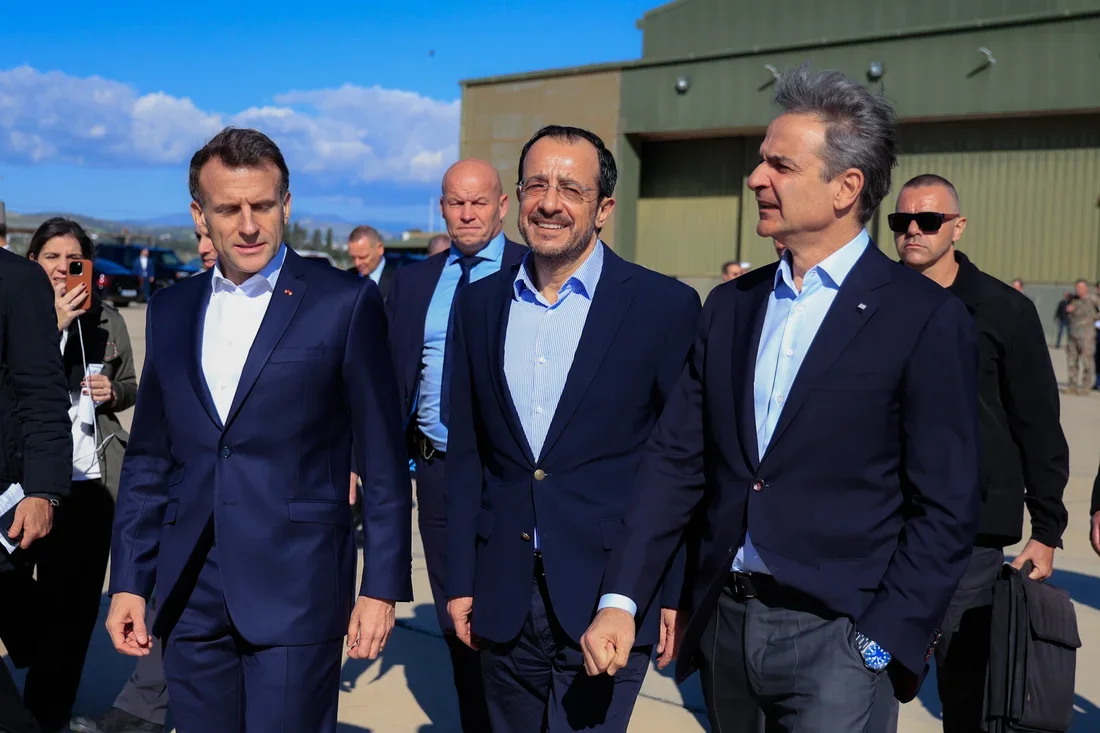
If it was destined to happen due to factors beyond Cyprus’ direct control, the attack on RAF Akrotiri by a Hezbollah-launched Shahed drone arrived at an opportune moment and lack of intensity for President Christodoulides. A week later, the head of state of one of the E.U.’s smaller and often forgotten nations found himself shoulder to shoulder not just with his usual counterpart, Greek PM Kyriakos Mitsotakis, but French President Emmanual Macron too, among others. While extending a forgiving hand to the Lebanese government for its impotence towards Hezbollah and a stern face to the U.K. for its involvement of Cyprus in regional wars, Christodoulides loudly called on Europe to come to Cyprus’ defense… and raised no issue when Türkiye responded.
With over half-a-dozen frigates in and around Cyprus, a British destroyer, attack helicopters, a French carrier group, and four Greek F-16s, Cyprus is finding more support from a single drone attack (on U.K.-controlled territory) than it ever received in 51 years of Turkish occupation. Of course, Türkiye did not miss the opportunity to reinforce its “Peace Force Command” with six F-16s and surface-to-air missiles, but it proved of less consequence than normal. Instead of prompting a standoff between Greece and Türkiye, Cyprus’ security seemed to bring the three nations, plus the U.K., into temporary lockstep. Between these arrivals, U.S. operations remain noticeably absent, or at least impressively discreet. In all likelihood though, there is not just one charade at play in Cyprus, but many.
The first and most obvious is that the time will come when the U.S. feels fully prepared to exercise its military-diplomatic investment on the island. Second, the idyllic picture of cooperation between Cyprus’ guarantor powers also meets the criterion of arms escalation and brinksmanship between Türkiye and its Hellenic neighbors. Third and reassuring to both, President Christodoulides’ career demonstrates many personal agendas and characteristics: a lack of intention and calculation is not among them. When the Iran War comes to an end, it is unlikely the military buildup will go unaddressed in the context of the Cyprus Problem, but given who the President is, it is unlikely to be addressed in the chaos of a national crisis.
Rather, Cypriots should expect to see well-choreographed negotiations and mutual de-escalation under the framework of joint cooperation. After all, Cyprus can ride at least one instance of successful guarantor cooperation and potentially draw back to a pre-1974 model of Turkish and Greek garrisons. The differentiating factor between then and now will be the self-regulation of cooperation under NATO auspices. If he’s as shrewd as he appears, President Christodoulides will try to meet this goal for Cyprus threefold: by modernizing the National Guard to NATO standards with U.S. support, by integrating into the Euro-Atlantic security framework through E.U. mutual defense, and by progressively raising and reducing the stakes between Cyprus, Greece, and Türkiye.
To the latter point, if that process isn’t delicately managed it risks boiling over into crisis for President Christodoulides and putting a sour taste in the mouths of both NATO and E.U. officials. Officials who, in turn, will refuse to advocate for Cyprus if it risks permanently alienating Türkiye. If executed correctly and with his normal deftness, however, he will achieve by far the most comprehensive breakthrough in the Cyprus Problem since the Turkish invasion and meet a deeply personal goal of his career and presidency.
In that way, the people of Cyprus should not regard these moves as separate or unrelated, but as cohesive blend of political breakaway from non-alignment, security reform that views Türkiye as a necessary stakeholder, and geopolitical deference that recognizes the U.S. as the pre-eminent power in the region. Perhaps President Christodoulides’ silence on this matter is a deliberate move to avoid uproar among the more entrenched of Cyprus’ political spectrum. Perhaps he is waiting for a precise moment to socialize his efforts to the nation he represents. Nevertheless, he should be cautious of being too discreet with his intentions and confusing a base of voters who will, from the left, accuse him of being a U.S. puppet and, from the right, of betraying Greeks’ natural victimization by Türkiye.
When all is said and done, President Christodoulides will require no assistance in managing the Cyprus Problem in his own way—apologies in advance to Tufan Erhürman and Maria Ángela Holguín—but without buy-in from the people of Cyprus, he may need to consider watching from the sidelines as another President mismanages a high-stakes game carefully cultivated since his days in the Foreign Ministry